

Quick Answer
The One Stop Shop (OSS) is an EU VAT scheme that allows businesses registered in Bulgaria to declare and pay VAT for qualifying cross-border EU B2C sales through one quarterly OSS return, instead of registering for VAT in multiple EU countries. OSS simplifies VAT compliance but does not replace Bulgarian VAT registration and does not apply to all transactions.
What is the One Stop Shop (OSS)?
The One Stop Shop (OSS) is an EU-wide VAT simplification mechanism designed to reduce the administrative burden for businesses selling goods or services to private consumers in other EU Member States.
Before OSS, even limited cross-border activity could trigger VAT registration obligations in multiple EU countries, each with its own reporting rules, deadlines, language requirements, and compliance risks. OSS addresses this by allowing VAT for specific cross-border B2C transactions to be declared and paid centrally in one Member State.
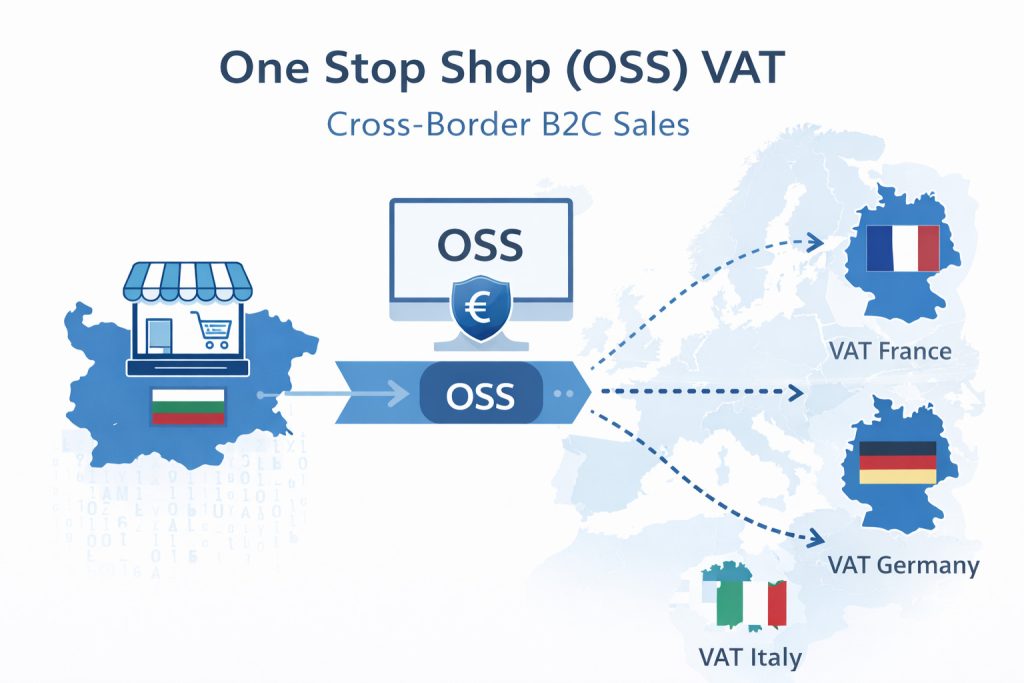
For businesses registered in Bulgaria, VAT due in other EU countries can be declared via the Bulgarian tax authorities, which then redistribute the VAT to the relevant Member States. OSS therefore simplifies reporting and payment, but it does not change where VAT is due.
OSS is one part of a broader EU VAT compliance framework and applies only to specific B2C transactions. It is often confused with other reporting obligations such as VAT returns, VIES, and Intrastat, which serve different purposes and apply to different transaction types.
For a clear overview of how VAT, OSS, VIES, and Intrastat differ — and when each applies in practice — see our comparison guide: VAT vs VIES vs OSS vs Intrastat.
OSS schemes in brief
The OSS framework consists of three distinct special regimes:
- Union OSS
- Non-Union OSS
- Import One Stop Shop (IOSS)
This article focuses on the Union OSS, which applies to EU-established businesses that choose Bulgaria as their Member State of identification and make qualifying B2C supplies to consumers in other EU countries.
The non-Union OSS and IOSS apply to different business models and are governed by separate rules.
Who can use OSS in Bulgaria?
OSS is intended for businesses that make B2C (business-to-consumer) supplies to customers located in other EU Member States.
In practice, Union OSS is suitable for:
- Bulgarian-established companies selling goods online to EU consumers
- Businesses supplying digital or electronically delivered services to EU individuals
- EU-established companies that choose Bulgaria as their Member State of identification for OSS purposes
OSS does not apply to B2B transactions, where VAT is generally handled under the reverse-charge mechanism, nor does it apply to purely domestic Bulgarian sales.
OSS operates alongside standard VAT registration and compliance rules in Bulgaria and applies only to qualifying cross-border B2C transactions.
OSS vs local VAT registration
One of the most common misunderstandings is the assumption that OSS eliminates the need for local VAT registrations. It does not.
| Aspect | OSS | Local VAT registration |
|---|---|---|
| Number of VAT numbers | One OSS registration | One per country |
| Scope | Cross-border B2C only | Domestic + cross-border |
| Reporting | Quarterly OSS return | Monthly / quarterly local returns |
| Domestic sales | Not included | Included |
| VAT number on invoices | No foreign VAT number | Local VAT number required |
| Administrative burden | Lower | Higher |
OSS simplifies how VAT is reported, not whether VAT obligations exist.
What transactions are covered by OSS?
Distance sales of goods (B2C)
OSS applies to goods shipped from Bulgaria to private consumers in other EU countries. VAT must be charged at the VAT rate applicable in the customer’s country, not the Bulgarian VAT rate.
For example, a Bulgarian webshop selling goods to customers in Germany and France must apply German and French VAT respectively. These sales can be declared in a single OSS return filed in Bulgaria.
This is especially relevant for companies operating an online webshop in Bulgaria that sell to consumers across multiple EU Member States.
Digital and electronically supplied services
OSS also covers digital services supplied to EU consumers, including:
- Software and SaaS subscriptions
- Online courses and digital training
- Streaming services
- Mobile applications and downloadable content
In all cases, VAT is due in the customer’s Member State of residence.
The EUR 10,000 threshold – how it works in practice
For EU-established suppliers using the Union OSS, a single EU-wide threshold of EUR 10,000 (net) applies to cross-border B2C supplies of services and distance sales of goods.
Below this threshold, Bulgarian VAT rules may continue to apply. Once the threshold is exceeded, VAT must be charged at the customer’s local VAT rate and reported via OSS.
The threshold:
- Is EU-wide (not per country)
- Applies jointly to digital services and distance sales of goods
- Applies retroactively within the calendar year once exceeded
Example
A Bulgarian company makes cross-border B2C sales as follows:
- Q1: EUR 3,000
- Q2: EUR 4,000
- Q3: EUR 5,000
The EUR 10,000 threshold is exceeded during Q3. From that point onward, VAT must be charged at the customer’s local VAT rate, and OSS becomes mandatory for the relevant supplies.
Businesses may also opt to use OSS voluntarily before reaching the threshold in order to simplify EU VAT compliance.
OSS registration in Bulgaria
OSS registration is completed electronically with the Bulgarian tax authorities.
From a practical perspective:
- Registration is optional until the EUR 10,000 threshold is exceeded
- Once exceeded, OSS becomes mandatory for qualifying supplies
- Registration generally takes effect from the next calendar quarter
Late registration often results in incorrect VAT invoicing and retrospective corrections, which increase compliance risk and administrative effort.
Official guidance on the One Stop Shop is published by the National Revenue Agency and is available here (in Bulgarian):
OSS Guidelines – NRA Bulgaria (PDF).
OSS reporting and payment obligations
OSS returns are submitted quarterly, regardless of the company’s regular Bulgarian VAT reporting cycle.
Key points:
- Returns are filed in EUR
- Deadline: end of the month following the reporting quarter
- VAT is paid in a single amount to the Bulgarian tax authority
- Corrections are made through future OSS returns, not by amending past filings
Accurate OSS reporting depends on proper bookkeeping and VAT reporting practices in Bulgaria, particularly where multiple VAT rates and jurisdictions are involved.
It is important to note that input VAT incurred in another EU Member State cannot be deducted through the OSS return. VAT on business expenses incurred abroad must be reclaimed separately through the applicable EU VAT refund procedures.
Failure to comply with OSS reporting obligations can lead to exclusion from the scheme and forced local VAT registrations across multiple EU countries.
OSS and Intrastat – different obligations
OSS and Intrastat serve entirely different purposes and are often confused.
- OSS is a VAT reporting mechanism for B2C sales
- Intrastat is a statistical reporting obligation for the physical movement of goods
A business may be fully compliant with OSS while still having Intrastat obligations in Bulgaria.
Common OSS mistakes in practice
In real-world cases, the most frequent issues include:
- Assuming OSS replaces Bulgarian VAT registration
- Applying OSS to B2B transactions
- Miscalculating or overlooking the EUR 10,000 threshold
- Applying incorrect VAT rates per Member State
- Ignoring Intrastat reporting obligations
Most problems arise when OSS is treated as a standalone solution instead of part of a broader EU VAT framework.
When OSS is not enough
OSS does not cover all VAT scenarios. Local VAT registrations remain necessary where a business:
- Stores goods in warehouses outside Bulgaria
- Makes domestic sales in another EU country
- Sells via marketplaces under specific deemed-supplier rules
- Imports goods from outside the EU (IOSS applies instead — the Import One-Stop Shop for goods valued at EUR 150 or less)
Frequently Asked Questions (FAQ)
Do I still need Bulgarian VAT if I use OSS?
Yes. OSS does not replace Bulgarian VAT registration.
Is OSS mandatory?
Yes, once the EUR 10,000 EU-wide threshold is exceeded.
Can non-EU companies use OSS in Bulgaria?
Generally no. Non-EU companies usually fall under IOSS or special non-Union schemes.
How often do VAT rates change?
VAT rates are determined by each EU Member State and may change independently.
Can OSS returns be corrected?
Yes, but only through future OSS returns, not by amending previously submitted returns.
Final thoughts
The One Stop Shop is a powerful VAT simplification tool — but only when applied correctly.
For businesses operating from Bulgaria, OSS should always be assessed together with Bulgarian VAT registration, Intrastat obligations, and the wider EU business model. OSS simplifies reporting, but it does not remove VAT liabilities or other compliance requirements.
Used properly, OSS reduces administrative burden and compliance risk. Used incorrectly, it creates both.
Disclaimer
This article is for informational purposes only and does not constitute Bulgarian or EU tax, legal, or accounting advice. VAT obligations depend on the specific facts and circumstances of each case. Professional advice should be obtained before taking action.
Last reviewed: January 2026
© 2011–2026 Aidos Accountancy Services. All rights reserved.