
Quick Answer
VIES in Bulgaria refers to the mandatory monthly VIES declaration that VAT-registered businesses must submit when supplying goods or services to VAT-registered companies in other EU member states. As of 2026, all VIES values are reported in EUR. VIES is a cross-border verification tool used by tax authorities to confirm the correct application of the reverse-charge mechanism and the 0% VAT rate on intra-EU B2B supplies.
What Is VIES?
VIES (VAT Information Exchange System) is an EU-wide reporting system used by tax authorities to cross-check intra-EU B2B transactions between VAT-registered businesses.
When a Bulgarian VAT-registered company supplies goods or services to a VAT-registered business in another EU member state, the supply is generally zero-rated in Bulgaria and taxed by the customer under the reverse-charge mechanism. VIES exists to ensure that these transactions are reported consistently by both parties.
Functionally, the VIES declaration is the EU equivalent of an EC Sales List, summarising a supplier’s intra-EU B2B transactions so they can be matched against acquisitions reported in other member states.
In practical terms, VIES allows tax authorities to:
- cross-check transactions reported by suppliers and customers in different EU countries
- verify the validity of EU VAT numbers
- monitor the correct application of zero-rating and reverse-charge rules
VIES forms part of the broader EU VAT framework explained in our overview of VAT in Bulgaria.
It is a verification tool, not a tax calculation or payment system.
VIES is often confused with other EU VAT reporting obligations such as VAT returns, OSS, and Intrastat. Each regime serves a different purpose and applies to different types of transactions.
For a clear overview of how VAT, VIES, OSS, and Intrastat differ — and when each applies in practice — see our comparison guide: VAT vs VIES vs OSS vs Intrastat.

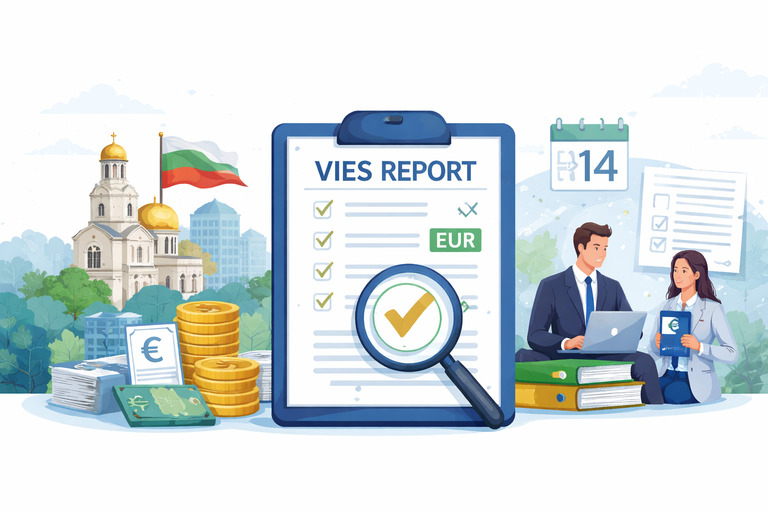
The infographic below shows how VIES fits into EU B2B VAT reporting at a glance.
Who Must File a VIES Declaration in Bulgaria?
In Bulgaria, the obligation to submit a VIES declaration is regulated and administered by the National Revenue Agency (NRA).
A VIES declaration is submitted by a VAT-registered taxable person who:
- performs intra-EU supplies of goods,
- acts as an intermediary in a triangular transaction, or
- supplies services to a taxable person established in another EU member state where the reverse-charge rules apply.
The reporting obligation lies with the Bulgarian supplier, who declares the transaction in their VIES declaration. The EU customer reports the corresponding acquisition or service in their own country’s VAT reporting system. This supplier–customer split enables EU-wide cross-checking.
Businesses that operate only domestically in Bulgaria, make B2C sales to EU consumers, transact exclusively with non-EU countries, or are not VAT-registered do not submit VIES declarations.
What Transactions Are Reported in VIES?
Intra-EU Supply of Goods
VIES covers intra-EU supplies of goods where physical goods are transported from Bulgaria to another EU member state and sold to a VAT-registered customer. These supplies are normally zero-rated in Bulgaria, provided that the customer’s EU VAT number is valid and the movement of goods can be proven.
The value reported in VIES must correspond to the value of zero-rated intra-EU supplies declared in the Bulgarian VAT return for the same period. Missing or inconsistent evidence can result in the zero rate being challenged.
Intra-EU Supply of Services (B2B)
B2B services are the most common source of VIES-related errors.
Services are reported in VIES when the customer is a VAT-registered business in another EU member state and the place of supply is determined under Article 44 of the EU VAT Directive. In such cases, VAT is reverse-charged to the recipient.
Typical examples include consultancy, IT and software services, marketing, and management services. Even though no VAT is charged on the invoice, the transaction must still be reported in VIES.
Some services are subject to special place-of-supply rules (for example, services related to immovable property or event admissions). Where the place of supply remains in Bulgaria, these services fall outside VIES, which is why correct classification is essential.
Monthly VIES Reporting in Bulgaria
In Bulgaria, the reporting period for VIES is always monthly.
A VIES declaration must be submitted for each month in which qualifying intra-EU supplies occur. It is filed electronically with the National Revenue Agency by the 14th day of the month following the transaction, aligning with the VAT return deadline.
If no qualifying intra-EU transactions occurred during a month, no VIES declaration is required.
Reporting Currency After Bulgaria’s Euro Adoption
As of 1 January 2026, Bulgaria has adopted the euro. All values reported in the VIES declaration and the corresponding VAT return are now filed in EUR.
Businesses using legacy systems that still calculate in BGN must apply the fixed conversion rate of 1.95583 and ensure that rounding complies with NRA requirements. Incorrect conversion or rounding can create reconciliation issues during audits.
EU VAT Number Validation (Official Source)
Before issuing an invoice or submitting a VIES declaration, businesses should verify their customer’s EU VAT number using the official VIES VAT number validation system provided by the European Commission:
Following Brexit, VAT numbers with the “GB” prefix are no longer valid for intra-EU VIES reporting. Only “XI” VAT numbers, issued under the Northern Ireland Protocol and applicable to goods only, may be valid within the EU VAT system.
Failing to validate VAT numbers is a frequent and entirely avoidable compliance risk.
Common VIES Mistakes
In practice, most VIES issues arise from avoidable compliance errors, such as:
- reporting B2C transactions in VIES
- failing to validate EU VAT numbers
- misclassifying goods and services
- inconsistencies between the VAT return and VIES
- late or incomplete submissions
These issues are typically bookkeeping-related rather than intentional.
Penalties and Risks of Incorrect VIES Reporting
Incorrect or missing VIES declarations can lead to administrative fines, increased audit scrutiny, and denial of zero-rated VAT treatment. In such cases, the NRA may reclassify the supply as domestic and assess 20% Bulgarian VAT plus interest.
Discrepancies are often identified years later through cross-border data matching, making retroactive corrections more complex and costly.
SAF-T and VIES (Note for Larger Businesses)
From January 2026, SAF-T in Bulgaria gives the NRA direct visibility into the transactional data underlying VIES declarations.. This increases the importance of consistency between accounting records, VAT returns, and VIES filings.
How Aidos Supports VIES Compliance
At Aidos, VIES reporting is handled as part of integrated EU VAT compliance rather than as a standalone filing. This includes VAT number validation, correct transaction classification, reconciliation between the VAT return and VIES data, and preparation of audit-ready documentation.
This approach is particularly important for service-based and internationally active businesses.
Frequently Asked Questions (FAQ)
Is VIES mandatory in Bulgaria?
Yes, if you are VAT-registered in Bulgaria and supply goods or services to VAT-registered EU businesses.
Do freelancers file VIES?
Yes, if they are VAT-registered and provide B2B services under reverse-charge rules.
Is VIES required if no VAT is charged?
Yes. VIES applies precisely because VAT is reverse-charged.
Are UK VAT numbers valid for VIES?
VAT numbers with the “GB” prefix are not valid for intra-EU VIES reporting. “XI” VAT numbers apply only to goods traded with Northern Ireland under the NI Protocol.
Conclusion
VIES in Bulgaria is a core element of EU B2B VAT compliance. It does not calculate tax, does not replace VAT returns, and does not apply to consumer sales. In 2026, with euro reporting and increased data visibility through SAF-T, accuracy and consistency matter more than ever.
For businesses operating across EU borders, correct VIES reporting from day one is essential.
Contact Us
Questions about VIES in Bulgaria, reverse charge, or EU B2B VAT?
Our team can review your setup and confirm whether your reporting is correct.
Disclaimer
This article is for informational purposes only and does not constitute tax, legal, or accounting advice. VAT obligations depend on specific facts and circumstances. Always seek professional advice before acting.
Last reviewed: June 2026
© 2011–2026 Aidos Accountancy Services. All rights reserved.